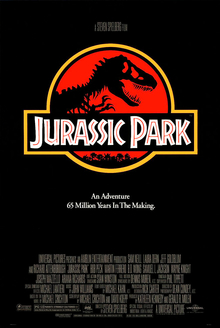
'Jurassic Park' (Steven Spielberg, 1993)
A build up to the action - the start of the film shows a man being killed by a dinosaur while working on the island. This is a very small piece that shwos what the film will all be about
Creation of fear/apprehension/anticipation/unsettling feeling/confusion/doubt over a character - there isn't one single main character, as it is a team of people - the film surrounds these people, rather than the other way round
Dark, shadowy atmosphere (use of light and dark images) - it is shot in a lot of undergrowth and in a park, so naturally, it is very dark
Establishing mood and atmosphere throughout the film - the film delves into the lives of each of the main characters
Delay in showing the face of a significant character, or the action of an important event by first showing the hand of a character for instance or a reaction of someone watching the event - as each character is introduced before the main action, there is no delay in character identification
Creation of suspense using soundtrack music - John Williams composed the soundtrack to the film, and it fits the action perfectly
Morally ambiguous central character - there is no central character
Murder encouraging a suspecting audience - there is very little murder, but there is a sense of inquisity into the whole idea of the island
Realistic settings to create a sense of the 'unusual' occuring within a normal setting - it is a fictional island based in the real world - and is commonly referred against real countries
Flashbacks - there are few flashbacks that have little significance to the main plots
Red herrings - there aren't any red herrings, but there are setbacks.
Twists and unexpected turns - there are few twists, which give them more 'power' to the film when used
Making and keeping the audience tense and on the edge of our seats - the film seems to go on and on, but each piece of action is another piece of the jigsaw - and once you are at the end of the film everything seems to make sense
Showing posts with label Forms and Conventions. Show all posts
Thursday, 18 February 2010
Researching Thriller Films - 'The Dark Knight' (2008)
'The Dark Knight' (Christopher Nolan, 2008)
A build up to the action - the start of the film involves The Joker raiding a bank - so the action starts straight away
Creation of fear/apprehension/anticipation/unsettling feeling/confusion/doubt over a character - there is a basic plot for each piece of action, but it elaborates and becomes mroe meaningfula s the film develops
Dark, shadowy atmosphere (use of light and dark images) - a lot fo the film is shot in very dark indoor locations
Establishing mood and atmosphere throughout the film - another dark film, that is a classic battle between good and evil
Delay in showing the face of a significant character, or the action of an important event by first showing the hand of a character for instance or a reaction of someone watching the event - the masks and face paint used against the two main characters give an extra dimension to the film
Creation of suspense using soundtrack music - the soundtrack is very similar throughout the film, which adds some continuity
Morally ambiguous central character - each of the central characters - Batman and The Joker - have different personalities dependent on who they are greeting
Murder encouraging a suspecting audience - each murder in the film adds to teh depth of the storyline
Realistic settings to create a sense of the 'unusual' occuring within a normal setting - it is based in the fictional city of Gotham, so the directors and producers can develop the city into whatever they want
Flashbacks - there are few flashbacks that have little significance to the main plots
Red herrings - there aren't any red herrings, but there are setbacks.
Twists and unexpected turns - there are few twists, as the film is about the good vs. evil battle
Making and keeping the audience tense and on the edge of our seats - the drama in each scene keeps the audience watching.
Labels:
Forms and Conventions,
Nolan,
Research,
The Dark Knight
Wednesday, 3 February 2010
Researching Thriller Films - 'The Godfather' (1972)
'The Godfather' (Francis Ford Coppola, 1972)
A build up to the action - the calm and serenity of the wedding allows for a dramatic piece of script writing when the action begins
Creation of fear/apprehension/anticipation/unsettling feeling/confusion/doubt over a character - the 'quiet before the storm' in each piece of action - means that you know something is about to happen, but don't know what yet
Dark, shadowy atmosphere (use of light and dark images) - a lot fo the film is shot in very dark indoor locations
Establishing mood and atmosphere throughout the film - it is quite a dark, sinister film, and is based on real-life 'events', as such. It can become quite threatening at times, but quite lethargic at others.
Delay in showing the face of a significant character, or the action of an important event by first showing the hand of a character for instance or a reaction of someone watching the event - this rarely happens, but can be seen later on in the film
Creation of suspense using soundtrack music - the soundtrack, written by Nino Rota, is one of the msot famous soundtracks of all-time. Instantly recognisable, it has become synonymous with 'The Godfather', and for this reason, the Italian flavours within the music has enabled the film to live scenes through the music, without dialogue.
Morally ambiguous central character - Michael Corleone is presented as a man who needs big shoulders to carry the weight of his father's empire.
Murder encouraging a suspecting audience - due to the nature of the film, murder doesn't encourage suspicion, because we know what is happening. Therefore, the film lacks a lot of inquisity.
Realistic settings to create a sense of the 'unusual' occuring within a normal setting - the film was shot in New York and Italy, where it is based.
Flashbacks - there are quite a few flashbacks to Michael's story, which adds to the character's background.
Hero in situation of threat or struggle - the threat from other mafia gangs creates a lot of tension within the film.
Red herrings - there aren't any red herrings, but there are setbacks.
Twists and unexpected turns - most of the film is straight-forward, with some occasional twists, such as the murder of Michael's brother, Sonny.
Making and keeping the audience tense and on the edge of our seats - the drama in each scene keeps the audience watching.
Monday, 30 November 2009
Researching Thriller Films - 'Vertigo' (1958)
'Vertigo' (Alfred Hitchcock, 1958)
Dark, shadowy atmosphere - A light, airy appartment - happiness?
Creation of suspense using soundtrack music - Violins in background, horns at action
Morally ambiguous central character - Character who asks Scotty to follow his wife
Murder encouraging a suspecting audience - Man falling from roof?
Realistic settings to create a sense of the 'unusual' occuring within a normal setting - Man still working with ex-fiancee
Flashbacks - Making out that man 'killed' man on roof
Hero in situation of threat or struggle - Flashback - 'saving' the man on the building
Twists and unexpected turns - They were engaged
Other notes - I didn't really like the film, and for that reason, I don't want to use any of the elements in my thriller. It seemed too thoughful to bring any drama to the viewer.
Researching Thriller Films - 'The Talented Mr Ripley' (1999)
'The Talented Mr Ripley' (Anthony Minghella, 1999)
A build up to the action - Massive fade in at the start
Creation of fear/apprehension/anticipation/unsettling feeling/confusion/doubt over a character - Keeps changing his name
Delay in showing the face of a significant character - Didn't show characters faces for a certain period
Creation of suspense using soundtrack music - Piano and singing - very slow
Morally ambiguous central character - Name change
Realistic settings to create a sense of the 'unusual' occuring within a normal setting - New York's jazz clubs
Flashbacks - Flashbacks to when he was younger
Other notes - I'm going to try and incorporate some of these elements into my thriller, as I think that the use of delaying showing the face of a character really added to the drama of the film. The choice of soundtrack is also something I may try and use, as I felt it really complimented the film well.
Labels:
Forms and Conventions,
Minghella,
Research,
Talented Mr Ripley
Researching Thriller Films - Forms and Conventions of a Thriller
Examples
- 'The Hitchhiker' (Ida Lupino, 1953)
- 'Vertigo' (Alfred Hitchcock, 1958)
- 'Psycho' (Alfred Hitchcock, 1960)
- 'Blue Steel' (Katheryn Bigelow, 1991)
- 'The Vanishing' (George Sluizer, 1993)
- 'Se7en' (David Fincher, 1995)
- 'The Usual Suspects' (Bryan Singer, 1995)
- 'Face/Off' (John Woo, 1996)
- 'Mimic' (Guillermo Del Toro, 1997)
- 'Sixth Sense' (M. Night Shyamalan, 1999)
- 'The Talented Mr Ripley' (Anthony Minghella, 1999)
- 'What Lies Beneath' (Robert Zemeckis, 2000)
- 'Phone Booth' (Joel Schumacher, 2002)
- 'One Hour Photo' (Mark Romanek, 2002)
What are the forms and conventions of a thriller?
- A build up to the action
- Creation of fear/apprehension/anticipation/unsettling feeling/confusion/doubt over a character
- Dark, shadowy atmosphere (use of light and dark images)
- Establishing mood and atmosphere throughout the film
- Delay in showing the face of a significant character, or the acion of an important event by first showing the hand of a character for instance or a reaction of someone watching the event
- Creation of suspense using soundtrack music
- Morally ambiguous central character (e.g. film noir - 'Se7en')
- Murder encouraging a suspecting audience
- Realistic settings to create a sense of the 'unusual' occuring within a normal setting
- Flashbacks
- Hero in situation of threat or struggle
- Red herrings (e.g. Hitchcock films)
- Twists and unexpected turns
- Making and keeping the audience tense and on the edge of our seats
Subscribe to:
Posts (Atom)
